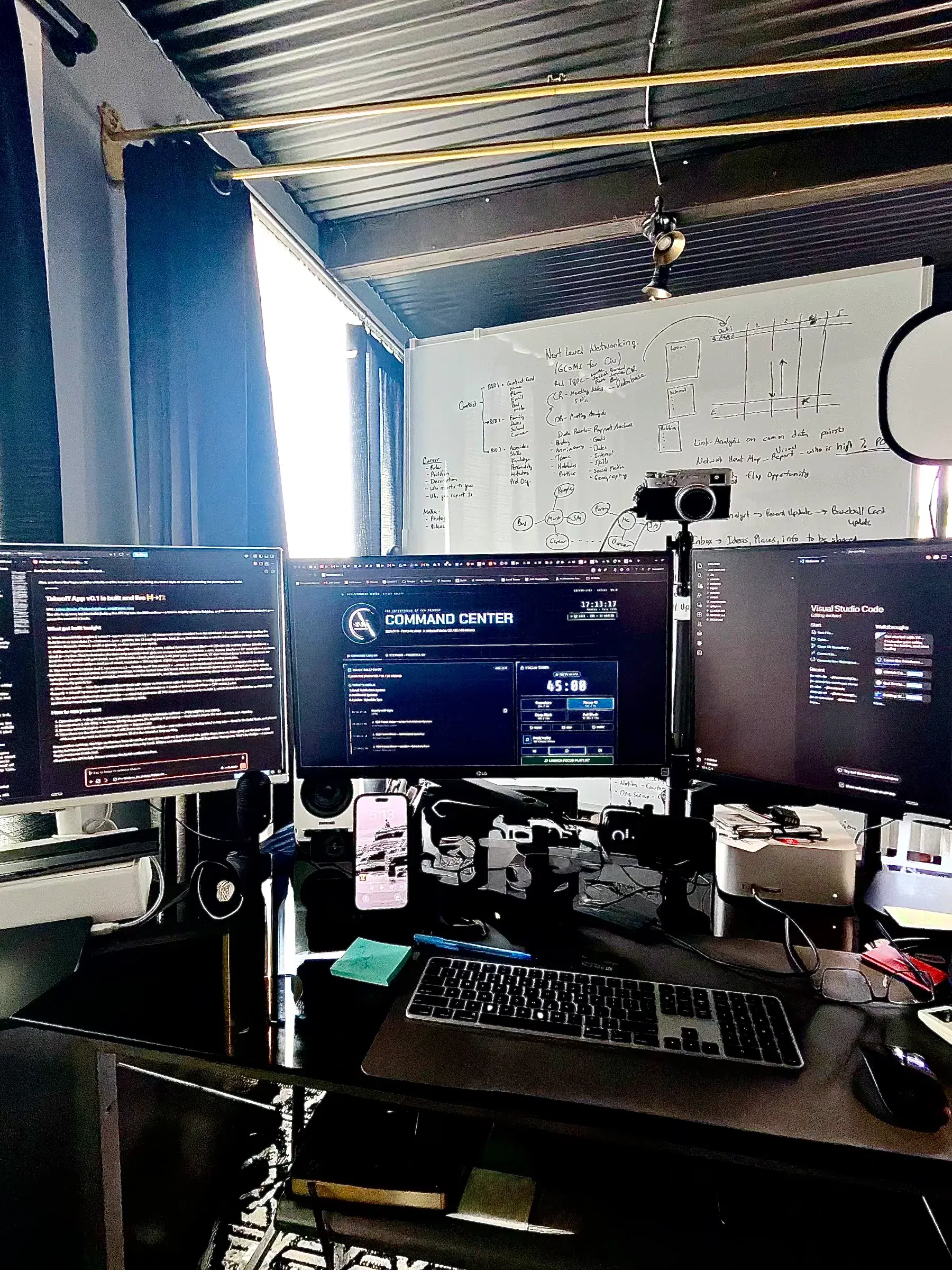
A photography company that operates like a tech company.
The short answer
JHR Photography is a Nashville corporate event photography company that runs on AI infrastructure. Three humans and a team of AI agents handle the scheduling, client communication, billing, assignments, and follow-up that would otherwise take two or three full-time hires. The tooling costs under $1,000 a month instead of $3,000 to $4,000 per person, and the capacity it freed up grew the business more than 50% in a year.
We are a tech company who happens to take photos.
Most people know JHR Photography by our work around Nashville, or by seeing me out in town.
Corporate events. Networking events. Trade shows. Executive imaging. Conference media. High-touch brand moments for clients who need the experience to feel polished, organized, and easy.
That is the business. Photography is still the product.
But the company behind that product isn't what you think it is.
What does it mean for a photography company to operate like a tech company?
Running a photography company like a tech company refers to building the operating system first and the service on top of it. The cameras did not change. What changed is that scheduling, client communication, billing, assignments, and content now move through systems instead of through my memory.
In practice it means that a two-person studio can answer a Nashville planner as fast as a twenty-person agency, because the answer does not wait on whoever happens to be free. The work of getting there involves mapping every repeatable step in the business and handing it to something that runs whether I am awake or not.
Over the past two years, I have converted JHR into an AI-forward family of businesses. I did not build this because I wanted to chase AI hype. I built it because the core business needed capacity before I could afford the staff.
The clients we serve do not just need someone with a camera. They need fast communication, clean planning, reliable follow-up, organized delivery, and a team that can move with them before, during, and after an event.
That takes infrastructure.
The traditional move for a photography business would be hiring. Add operations. Add marketing. Add admin support. Add help with scheduling, finance, assignments, website content, and client experience.
That support would be valuable. It would also be expensive. What usually happens is that the owner ends up doing it all themselves. I didn't want to build the company that way.
How much does an AI-run back office actually cost?
The systems we use now cover what 2 or 3 people would do at a cost of $3,000 to $4,000 per person per month, and we simply couldn't afford that.
My total AI and tooling spend is still under $1,000 a month, and often closer to $500 for the core subscriptions.
That is the math that changed everything. From a production standpoint, that's a minimum savings of $2,500 a month at our current operational level. That AI infrastructure supports 3 companies, not just one. That's a conversation for another time.
The staff I couldn't afford, I built
JHR now runs with three humans and a team of AI agents.
Some agents live in Slack. They provide daily updates, scheduling, financial visibility, photographer assignments, billing, payables, client workflows, and internal planning. Slack is our command center because I can run the business from text and voice instead of sitting down at a computer with four different pieces of software and a dozen tabs.
The tools behind the team
A lot of that structure developed from second-brain thinking. Nate Herk was one of the first people who introduced me to the concept, and it pushed me to think differently about our company knowledge. With a tool like Obsidian, lessons learned and event insights become more than Post-it notes. Obsidian became a working memory layer for the business: process notes, strategy, decisions, voice, lessons, and the kind of context that is usually locked inside the owner's head.
Notion became our program of record. I was tired of paying subscriptions to CRM and photo-specific services that ultimately controlled my data.
Matthias Frank helped me understand the power of Notion as a business system, not just a prettier notes app or CRM. Notion captures all the mechanics: deals, tasks, production details, client records, content planning, and operating dashboards. It is all real-time and accessible by the team, human and AI.
This solved a real problem. There was no way to scale if every question and decision was locked in my head.
For routine, repeatable, and daily tasks, we use Hermes Agent from Nous Research, hosted on Hostinger VPS. This lets the agents work 24 hours a day, 7 days a week. That idea came from studying people like Nate B Jones, especially the way he thinks about agents, workflows, and the philosophy of working with AI inside an organization.
So much of my day was consumed by simple workflow steps. Once those steps were mapped, the agents could handle them. Each one is an employee with a task, guides, and guardrails I can trust. This lifted a significant amount of routine work off the humans.
The business is not on autopilot. The agents do not replace judgment. They handle more of the monitoring, drafting, organizing, routing, and follow-up so the humans can focus on the work that actually needs us.
On the website side, OpenAI- and Anthropic-powered systems help us bring in business and stay focused on performance through AI search, SEO, content structure, and client experience.
Why better systems changed what we shoot in Nashville
This transformation went well beyond task automation. It required changing how I see my company.
AI helped me look at the business more clearly: which clients were the best fit, which offers had the strongest margin, which markets deserved more focus, and where we were spending energy that did not match the future of the company.
That is why JHR Photography shifted its focus to the corporate and commercial event space across Nashville and Middle Tennessee. The Nashville corporate calendar runs through rooms like Music City Center and Gaylord Opryland, and those clients value organization as much as creativity. They need visual media that supports the business purpose of the event, not just a folder of nice images afterward. That is what our corporate event coverage, trade show media, and executive imaging work is built around.
Our systems make us better for that client. We understand them and their market better. We can plan faster, improve information flow, deliver more cleanly, follow up more consistently, and turn their content into useful business assets.
Over the last year, JHR grew more than 50%. That isn't a magic AI button. The growth came because we had the capacity to focus on the right work.
We are not about replacing people
I want humans in the seats managing these operations, but they are going to manage the AI tools that help them do it. I don't want 10 fewer employees. I want employees who are 10 times more productive. By focusing on AI infrastructure early, I was able to build the support layer before I could afford the staff.
There is still human judgment everywhere. The client experience still needs taste, timing, relationship, trust, and accountability. An agent can't walk into a ballroom and read the room. It does not know how to make an executive comfortable in front of a camera. It does not know when a planner is stressed and needs someone to simplify the next ten steps.
Humans still own that part. We do it, and we do it well. The agents carry the operational tasks so we can do what we do best.
I believe this is the model more small businesses will begin to adopt. Not because every business wants to become a tech company, but because every business has work that can be organized, supported, monitored, drafted, routed, and improved with better systems.
I learned a lot of these concepts by watching Greg Isenberg's interviews. I treat his YouTube channel like an ongoing business and technology master class. I don't copy every idea. That isn't the point. But this space is moving so fast and changing daily that it's critical to see how other operators think about AI-native businesses, adopt what works, and learn how small teams can test ideas faster than they used to, and faster than established organizations.
From the outside, JHR Photography still looks like a photography company. That is fine. Clients do not need to see the nerd fest behind the scenes. They need the experience to feel personal, organized, responsive, and professional. They need to trust us, and our AI tools help make that happen. You can read more about how we work if you want the longer version.
JHR is still a photography company.
But if a tech company is a company that uses technology as a core part of how it creates value, serves clients, makes decisions, and scales operations, then JHR is also a tech company now.
We just happen to carry cameras.
If you run a small business that still depends on manual follow-up, scattered notes, disconnected tools, or the owner remembering everything, I am happy to talk through what we have learned. Not to sell you a magic system. Just to share what has worked, what has not, and where I think analog businesses can start adapting. Start a conversation with us.